Cost of Living Comparison: Franklin, TN vs. Austin, TX
Franklin, TN vs. Austin, TX — how do property taxes, home prices, schools, and quality of life compare? Here's an honest breakdown for families considering the move.
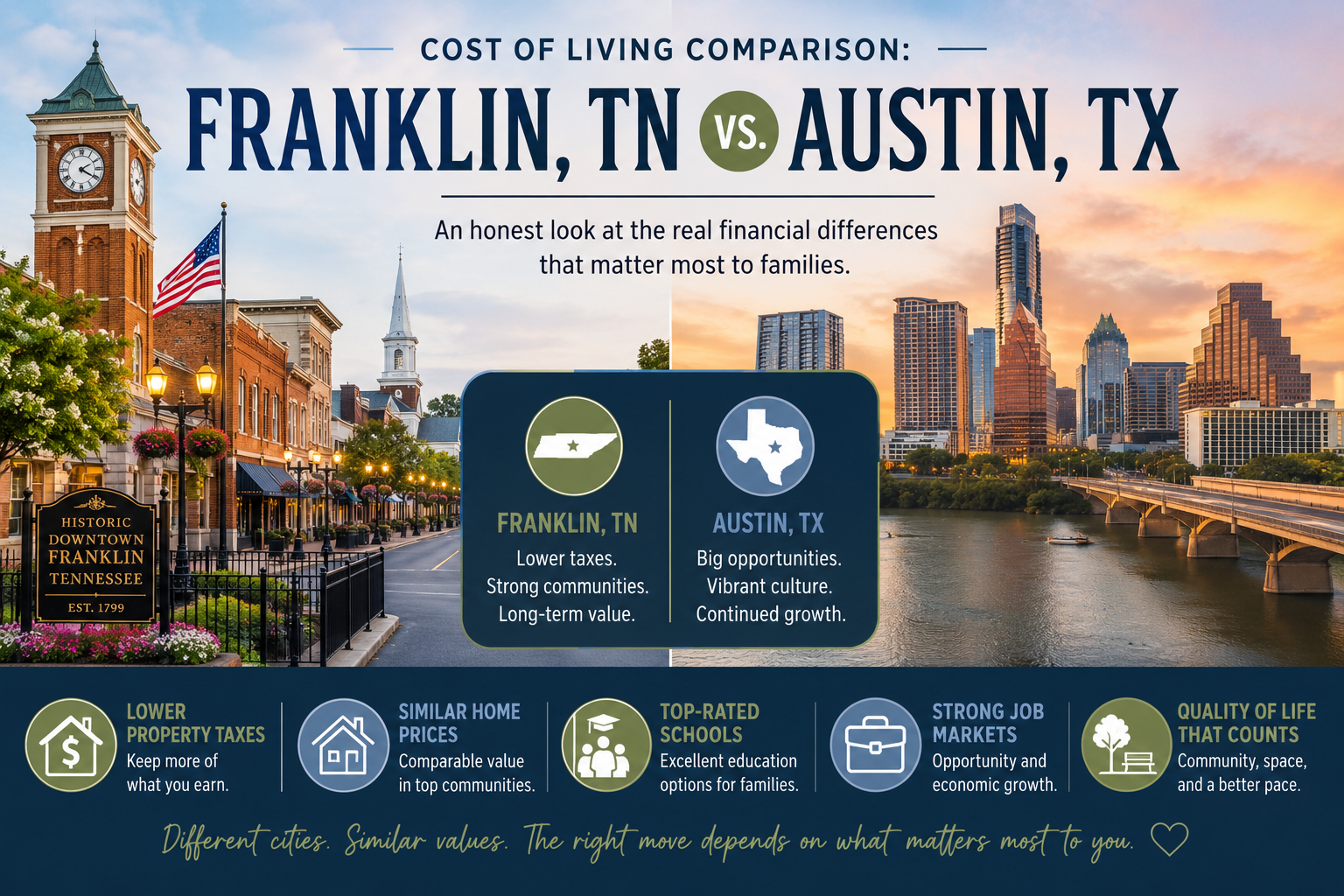

Cost of Living Comparison: Franklin, TN vs. Austin, TX
Austin has had one of the most remarkable runs of any American city over the past fifteen years. The tech industry arrived, the population exploded, and a city that was once celebrated for its affordability became one of the most expensive real estate markets in the country practically overnight. For many Austinites — and for Texans in the Dallas and Houston metros who watched Austin's trajectory and felt it ripple into their own markets — the question has shifted from "why would I leave Texas?" to "where would I go if I did?"
Middle Tennessee — and Franklin and Williamson County specifically — has emerged as one of the most consistent answers to that question. The two communities share some important characteristics: no state income tax, strong job markets, population growth, and a quality of life that attracts people from across the country. But they differ in ways that matter significantly to families trying to make a smart long-term financial decision. Here is an honest, detailed comparison.
The Income Tax Wash — And Why It Still Matters
Let's address the most obvious comparison point first. Both Texas and Tennessee have no state income tax on wages or salaries. This is one of the most important financial advantages of living in either state, and it is a characteristic they share equally — so it doesn't create a financial differential between the two destinations.
What it does do, however, is make both Franklin and Austin compelling destinations for people leaving high-income-tax states like California, Illinois, or New York. If you're already in Texas and considering a move to Tennessee, the income tax comparison is a wash. But if you're in California thinking about whether to go to Austin or to Franklin, the income tax advantage applies equally to both — and the comparison shifts to the other financial variables that do differ between the two markets.
Property Taxes: A Meaningful Difference
This is where the comparison between Texas and Tennessee becomes genuinely significant — and where Franklin has a clear financial advantage over Austin.
Texas has one of the highest effective property tax rates in the country, consistently ranking in the top five states nationally. The effective property tax rate in Travis County — which includes Austin — typically runs in the range of 1.8% to 2.2% depending on the specific municipality and any applicable exemptions. In Williamson County, Tennessee — which covers Franklin, Brentwood, Thompson's Station, and surrounding communities — the effective property tax rate typically runs in the range of 0.45% to 0.65%.
What this means in dollars:
On a $700,000 home in Austin, annual property taxes might run $12,600 to $15,400 depending on the exact location and applicable exemptions.
On a $700,000 home in Franklin, annual property taxes might run $3,150 to $4,550.
Annual savings: $8,050 to $10,850.
Over a ten-year period of homeownership, that difference compounds to $80,500 to $108,500 in cumulative property tax savings — before accounting for any appreciation in tax rates, which Texas has historically experienced as home values have risen.
For families who have been watching their Travis County property tax bills climb year after year alongside Austin's home value appreciation, this comparison is one of the most compelling arguments for a Franklin relocation. Tennessee's property tax system is dramatically more favorable, and the annual savings are real money that compounds meaningfully over time.
Home Prices: A More Nuanced Comparison
Austin's real estate market experienced extraordinary appreciation between 2019 and 2022, with median home prices roughly doubling in some submarkets during that period. Since then, Austin has seen some price correction — one of the more significant corrections of any major Sun Belt market — as the inventory of new construction absorbed some of the demand surge and rising interest rates reduced buyer purchasing power.
Franklin's market has been more stable. Prices appreciated meaningfully during the same period but without Austin's extremes, and the subsequent correction has been more modest — reflecting Williamson County's more constrained supply and consistently strong demand fundamentals.
Current price landscape:
The median home price in Franklin generally runs in the range of $700,000 to $850,000 depending on neighborhood and property type. Well-regarded neighborhoods like Sullivan Farms, Stream Valley, and Fieldstone Farms offer quality homes in the $600,000 to $900,000 range.
Austin's median home price has pulled back from its 2022 peak and currently sits in a range that varies significantly by submarket — from the mid-$400,000s in outer suburbs to $800,000 and above in desirable central and near-central neighborhoods. In the Austin suburbs that most directly compete with Franklin for the same buyer profile — communities like Westlake, Lakeway, and Cedar Park — pricing is comparable to or in some cases exceeds Franklin's.
The bottom line on home prices: At comparable quality and community levels, Franklin and Austin's most competitive suburbs are similarly priced. The meaningful financial differentiator is not the purchase price — it is the ongoing property tax savings that Franklin delivers year after year after year.
Cost of Living Beyond Housing
Housing and property taxes dominate the cost of living comparison between Franklin and Austin, but the other components of daily life are worth understanding as well.
Groceries: Both Franklin and Austin have comparable grocery costs. Tennessee's sales tax applies to groceries at a reduced rate of 4% — lower than the standard rate but still a consideration. Austin's grocery prices reflect both Texas's tax structure and the premium pricing that high-income, high-demand markets tend to generate. The difference is marginal between the two markets.
Dining and entertainment: Austin has a larger and more diverse dining and entertainment scene — the city is significantly larger than Franklin and has the restaurant depth, live music culture, and nightlife infrastructure of a major city. Franklin's restaurant scene is excellent for its size — Puckett's, Gray's on Main, Cork & Cow, and a strong lineup of local restaurants give residents genuine quality — but it does not have Austin's breadth. For buyers who place high value on big-city dining and entertainment variety, Austin has the edge.
Healthcare: Both markets have strong healthcare infrastructure. Nashville — 21 miles from Franklin — is one of the most significant healthcare industry hubs in the country, with Vanderbilt University Medical Center and a network of major healthcare providers giving Franklin residents access to exceptional medical care. Austin has strong healthcare options as well, anchored by the University of Texas medical programs and a growing healthcare sector.
Transportation: Both Franklin and Austin are car-dependent communities. Neither has meaningful public transit infrastructure for suburban residents. Austin's traffic has become one of the most significant quality-of-life complaints among its residents — the city's rapid growth has outpaced its road infrastructure in ways that create genuinely punishing commute times in many corridors. Franklin has its own traffic challenges along I-65 and the Cool Springs corridor, but by Austin's standards, Franklin's traffic is manageable.
Utilities: Middle Tennessee's climate means meaningful heating costs in winter — something that Austin, with its milder winters, generally avoids. On the other hand, both markets have hot summers that drive significant air conditioning costs. Utility costs are broadly comparable between the two markets on an annual basis.
Quality of Life: Where They Differ
Both Franklin and Austin offer high quality of life — that is not in question. But they offer different versions of it, and understanding those differences is important for making the right relocation decision.
Austin is a city in the truest sense — large, diverse, culturally rich, and buzzing with the energy of a major metro that has been growing rapidly for years. The live music scene is world-class. The restaurant and bar culture is vibrant. The University of Texas brings intellectual and athletic energy. The tech industry has created a highly educated, well-compensated professional class that has shaped the city's culture, its neighborhoods, and its social scene.
What Austin has lost in the process of its growth is some of the things that made it beloved in the first place — affordability, traffic manageability, a sense that the city belonged to the people who had always lived there rather than the people who had just arrived. Long-time Austinites will tell you that the city has changed enormously, and not entirely for the better.
Franklin is a smaller, quieter, more community-oriented version of the good life. The historic downtown is genuine and beloved. The schools are exceptional. The neighborhoods are safe and well-maintained. The community culture — faith-forward, family-oriented, neighborly in a way that large metros rarely achieve — provides a social fabric that many Austin transplants describe as one of the most welcome surprises of their move.
What Franklin lacks relative to Austin is scale. The restaurant scene, the live music scene, the nightlife, the cultural diversity — all of these are smaller in Franklin than in Austin. Nashville, 21 miles away, compensates for some of this, but Franklin is not Nashville, and buyers who are specifically seeking a major-city cultural environment will find Austin the stronger option.
The Bottom Line: Who Should Choose Franklin Over Austin?
Franklin makes more financial sense than Austin if:
- Property taxes are a significant concern — the annual savings in Franklin are real and meaningful for most households
- You prioritize a smaller, quieter community over a larger, more urban environment
- Top-rated public schools are a primary decision driver and you want a district with consistent excellence across all grade levels
- You are relocating from a state with high income taxes and want the no-income-tax advantage without Austin's property tax burden
- You value community character, neighborliness, and a slower pace of life over big-city energy and entertainment
Austin may be the better fit if:
- You specifically want a larger city with more cultural diversity, dining variety, and nightlife
- Your professional network or industry is deeply rooted in Austin's tech ecosystem
- You prefer a more urban lifestyle with more walkable city neighborhoods
- You are not as sensitive to the property tax differential and prioritize city scale over financial efficiency
For many Texas families — particularly those who have been watching their property tax bills climb and their Austin commute lengthen — Franklin represents a genuine upgrade on the financial metrics that matter most, delivered in a community that meets or exceeds Austin's quality of life on the dimensions that families with children tend to prioritize most.
FAQ: Franklin, TN vs. Austin, TX Cost of Living
Is Franklin, TN cheaper than Austin, TX? On a home purchase price basis the markets are broadly comparable at similar quality levels. The meaningful financial advantage of Franklin over Austin is in property taxes — Williamson County's effective rate of 0.45% to 0.65% versus Travis County's 1.8% to 2.2% represents annual savings of $8,000 to $11,000 on a $700,000 home. Over a decade of homeownership that difference is substantial.
Do both Texas and Tennessee have no state income tax? Yes — both Texas and Tennessee have no state income tax on wages or salaries. This is a characteristic they share equally and does not create a financial differential between the two destinations.
How do the school districts compare between Franklin and Austin? Williamson County Schools is consistently ranked as one of the top school districts in Tennessee and one of the strongest in the Southeast. Austin ISD serves a large and diverse urban district with significant variation in school quality across different parts of the city. For families prioritizing consistent, high-level public school quality across all grade levels, Williamson County Schools generally offers a more uniform standard of excellence than Austin ISD's highly variable landscape.
Is Austin or Franklin better for families? Both are good for families, but they offer different experiences. Franklin offers top-rated schools, low crime, a quiet community character, and a neighborly culture that families consistently describe as one of their favorite things about the move. Austin offers more cultural diversity, more urban amenities, and a larger city environment. The better fit depends on whether you prioritize community character and school quality or urban scale and cultural variety.
How does traffic compare between Franklin and Austin? Austin's traffic has become one of its most significant quality-of-life challenges, with commute times that rank among the worst of any Sun Belt city. Franklin has its own traffic along I-65 and the Cool Springs corridor, but by Austin's standards it is manageable. Most Austin transplants to Franklin report a meaningful improvement in their daily commute experience.
What is the property tax rate in Franklin, TN? Williamson County's effective property tax rate typically runs between 0.45% and 0.65% depending on the specific municipality and any applicable exemptions. This is among the lowest effective property tax rates in Tennessee and dramatically lower than what Texas homeowners typically pay.
Weighing a move from Austin or anywhere in Texas to Middle Tennessee? I work with Texas buyers regularly and can help you run the real numbers on what a Franklin relocation would mean for your household financially — and help you find the right community and the right home when you're ready to make the move.
Billy Larsen | Larsen Home Group
- 📞 949-533-6648
- 📧 billy@billylarsen.com
- 🌐 www.larsenhomegroup.com
Specializing in helping out-of-state buyers — including many from Texas — relocate to Franklin and the greater Williamson County area.