5 Common Mistakes When Going Through Probate in Middle Tennessee
Navigating probate in Middle Tennessee? Here are the 5 most common and costly mistakes families make — and how to avoid them.
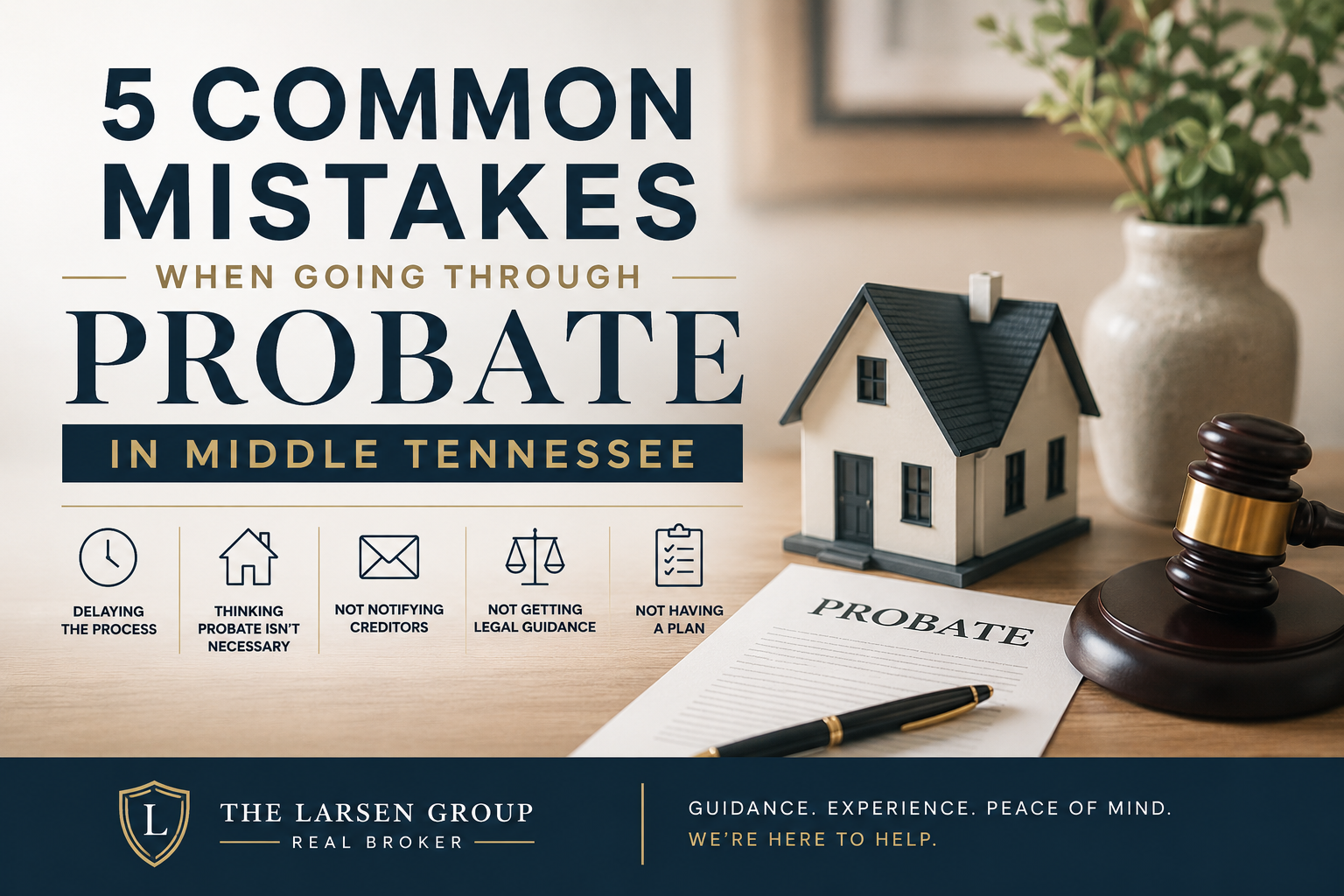

5 Common Mistakes When Going Through Probate in Middle Tennessee
Probate is one of those legal processes that most people encounter for the first time during one of the hardest periods of their lives. You're grieving, you're busy, and suddenly you're responsible for navigating a court process with deadlines, legal requirements, and financial implications that you've never dealt with before. It's a difficult combination — and it's exactly the kind of environment where costly mistakes happen.
Middle Tennessee follows Tennessee state probate law, and while the process is more straightforward here than in some states, there are specific mistakes that come up repeatedly — mistakes that delay the process, create legal complications, reduce the value of the estate, or create lasting family conflict. This post is written to help families avoid the most common ones.
As always, this is not legal advice. If you are actively navigating a probate proceeding in Tennessee, working with a licensed Tennessee estate attorney is strongly recommended. What follows is a practical guide based on commonly observed patterns — not a substitute for professional legal counsel.
Mistake #1: Waiting Too Long to Open the Estate
This is the single most common mistake families make in Middle Tennessee probate proceedings — and it is also one of the most consequential. When a loved one passes away, the emotional weight of the moment makes it easy to set aside the practical and legal responsibilities that come with it. Grief is real, and the impulse to take time before dealing with paperwork and courts is understandable. But Tennessee law imposes specific deadlines that do not pause for grief.
What Tennessee law requires: Tennessee requires that a will be filed with the court within 60 days of the deceased's death. While the probate estate does not have to be formally opened immediately, waiting too long creates a cascade of problems that are difficult and expensive to unwind.
What happens when you wait: Bills continue to accrue on the estate's accounts. Property taxes come due. Homeowner's insurance can lapse if the insurer is not notified of the owner's death. Utilities get disconnected. And in some cases, property can deteriorate significantly — particularly if it sits vacant for months before the estate is administered.
Beyond the practical deterioration of assets, waiting to open the estate can create legal complications. Creditors may take action. Family members may make unauthorized decisions about estate property. And the longer the estate sits unattended, the more complicated the eventual probate proceeding tends to become.
What to do instead: Contact a Tennessee estate attorney within the first few weeks after a loved one's death. Even if you're not ready to make decisions about assets or distribution, getting the legal framework in place quickly protects the estate and gives you a clear roadmap for the process ahead.
Mistake #2: Assuming Probate Isn't Necessary
The flip side of waiting too long to open the estate is assuming that probate isn't necessary at all — and failing to take the legal steps required to properly transfer property as a result. This mistake is surprisingly common, particularly among families who believe that because they are the obvious heir, or because the deceased expressed their wishes verbally, or because the will clearly states who gets what, the property simply transfers without any formal process.
Why this assumption is dangerous: In Tennessee, real estate does not transfer automatically at death unless the property was titled in a specific way — joint tenancy with right of survivorship, a Transfer on Death Deed, or a living trust. If the deceased owned real property solely in their own name, that property cannot be sold, refinanced, or transferred to heirs without going through probate or another court-supervised process. Period.
Families who discover this reality after the fact — often when they try to sell an inherited property and the title company identifies the problem — face a retroactive probate process that is more expensive, more time-consuming, and more complicated than a timely filing would have been.
Common scenarios where this mistake occurs: A surviving adult child moves into a parent's home and continues paying the property taxes, assuming the property is now theirs. A family informally agrees to divide the estate among themselves without involving the court. An heir tries to sell an inherited property years later and discovers that title was never properly transferred.
What to do instead: Before assuming that probate is or isn't necessary, consult with a Tennessee estate attorney who can review how the property was titled, whether a will exists, and what the correct legal pathway is for your specific situation. This consultation is typically inexpensive relative to the cost of sorting out the problem later.
Mistake #3: Failing to Properly Notify Creditors
Tennessee law requires that creditors be notified of an estate's opening and given an opportunity to file claims against the estate. This is not optional, and the consequences of getting it wrong can be significant. Yet it is one of the steps that families — particularly those navigating probate without an attorney — most commonly handle incorrectly or incompletely.
What Tennessee law requires: Once the estate is opened, the executor or administrator is required to publish a notice to creditors in a newspaper of general circulation in the county where the deceased resided. Creditors then have four months from the date of the first publication to file claims against the estate. Known creditors — those the executor is aware of — should also be notified directly.
Why this step matters: Creditors who are not properly notified can potentially bring claims against the estate — or in some cases against the heirs themselves — after assets have been distributed. An executor who distributes estate assets before the creditor claim period has expired without properly notifying creditors can face personal liability for those creditor claims.
Common mistakes: Failing to publish the required newspaper notice. Notifying known creditors but failing to follow the formal publication requirement. Distributing estate assets before the four-month creditor claim period has expired. Overlooking lesser-known obligations such as Medicaid estate recovery claims, which Tennessee actively pursues against estates of deceased Medicaid recipients.
What to do instead: Follow the creditor notification requirements precisely and document that you have done so. Do not distribute estate assets to heirs until the creditor claim period has fully expired and all valid claims have been addressed. An estate attorney can guide you through this process and help you avoid the personal liability that can result from getting it wrong.
Mistake #4: Mishandling the Real Estate
Real estate is often the most valuable asset in a Middle Tennessee estate — and it is also the asset that generates the most mistakes, the most family conflict, and the most significant financial consequences when it is mishandled during the probate process.
Failing to get a proper appraisal. One of the most financially consequential mistakes families make with inherited real estate is failing to obtain a formal appraisal at the date of death. This appraisal establishes the stepped-up cost basis — the value at which the heirs inherit the property for capital gains tax purposes. Without a formal appraisal, heirs may face IRS scrutiny when they eventually sell the property, and they may pay significantly more in capital gains taxes than they would have with proper documentation in place.
The appraisal should be performed by a licensed Tennessee appraiser as close to the date of death as possible. This is not a step to skip or defer.
Making decisions about the property before probate is complete. Families sometimes make premature decisions about inherited real estate — listing the property for sale, renting it out, or beginning renovations — before the property has been formally transferred to the heirs through the probate process. These actions create legal and title complications that can delay or derail a subsequent sale, create liability issues, and generate family conflict when other heirs disagree with the decisions being made.
Letting the property deteriorate. Vacant properties deteriorate. This is a straightforward reality that families navigating lengthy probate proceedings sometimes underestimate. Deferred maintenance, weather damage, vandalism, pest infestations, and utility issues can all reduce the value of an inherited property significantly during the time it takes to complete the probate process. Regular property inspections, maintaining utilities, keeping insurance in force, and addressing maintenance issues promptly are all important responsibilities of the executor during the administration period.
Underpricing or overpricing when selling. When inherited properties eventually go to market, they are sometimes priced based on emotional attachment, family disagreement, or outdated assumptions about value rather than current market data. An overpriced property sits, accumulates days on market, and ultimately sells for less than it would have with correct pricing from the start. An underpriced property leaves money on the table that rightfully belongs to the heirs.
What to do instead: Get a formal appraisal immediately after the death. Do not make material decisions about the property until the estate is properly opened and you have legal authority to act. Maintain the property actively throughout the probate process. And when the time comes to sell, work with a local real estate agent who has experience with estate sales and who will provide honest, data-driven pricing guidance rather than telling you what you want to hear.
If you are selling an inherited property in Middle Tennessee, Billy Larsen of Larsen Home Group is an experienced resource for exactly this kind of transaction. Billy specializes in helping out-of-state heirs and families navigate the sale of inherited properties in Franklin and the greater Williamson County area — providing objective market analysis, coordinating between multiple heirs in different states, and working alongside estate attorneys to make the process as smooth as possible during what is often a difficult time. You can reach Billy at billy@billylarsen.com, 949-533-6648, or www.larsenhomegroup.com.
Mistake #5: Letting Family Conflict Drive Legal and Financial Decisions
Probate brings families together under the worst possible circumstances — grief, financial stress, and the need to make consequential decisions quickly. It is a combination that reliably produces conflict, and family conflict during probate is one of the most common sources of costly mistakes, delayed proceedings, and permanently damaged relationships.
What conflict looks like in probate: One sibling wants to sell the family home immediately to divide the proceeds. Another wants to keep it in the family. A third wants to move in. All three have equal ownership interests and none of them can agree. Meanwhile the property sits, accumulates taxes and maintenance costs, and loses value while the legal dispute drags on.
Or: one family member was closer to the deceased, was involved in their care, and believes they deserve a larger share of the estate than the will provides. They contest the will, triggering a legal proceeding that consumes a significant portion of the estate in legal fees before it is resolved.
Or: an executor — often the oldest child or the person the deceased trusted most — makes unilateral decisions about estate property without consulting the other heirs, creating resentment and legal exposure that could have been avoided with transparent communication and proper legal guidance.
Why this mistake is so costly: Family conflict during probate is expensive in every possible dimension. Legal fees for contested proceedings can consume a substantial portion of the estate's value. The emotional cost to family relationships can be permanent. And the practical cost — properties that sit unsold, assets that deteriorate, decisions that get delayed — compounds throughout the dispute.
What to do instead: Establish clear communication protocols among all heirs from the beginning of the process. Involve an estate attorney who can serve as a neutral authority on what is legally required versus what individual family members want. When disagreements arise, consider mediation before litigation — it is faster, less expensive, and more likely to preserve family relationships. And if you are the executor, document every decision you make and communicate transparently with all interested parties rather than making unilateral calls that other heirs will later contest.
One of the most useful things an executor can do early in the process is engage a local real estate agent to provide a professional market analysis of any real estate in the estate. Having an objective, third-party assessment of value takes the pricing conversation out of the realm of family opinion and into the realm of market data — which tends to reduce conflict significantly and gives all heirs a neutral foundation for their decision-making.
A Note on Going It Alone
Tennessee does not require an attorney for probate proceedings, and for very simple estates with clear titles, no real estate, no creditor disputes, and complete family agreement, some executors manage the process without legal counsel. But for any estate that involves real property — which describes the majority of Middle Tennessee estates with meaningful value — the cost of an estate attorney is almost always justified by the protection it provides.
The most expensive probate mistakes are almost always ones that could have been avoided with early, competent legal guidance. The attorney's fee is not a cost — it is insurance against errors that can cost multiples of what the attorney charges.
FAQ: Probate Mistakes in Middle Tennessee
What is the most common probate mistake in Tennessee? Waiting too long to open the estate is the most common and consistently costly mistake. Tennessee requires that a will be filed within 60 days of death, and delays beyond that create a cascade of practical, legal, and financial complications that are expensive to unwind.
Can an executor be held personally liable for probate mistakes in Tennessee? Yes — an executor who fails to properly notify creditors, distributes estate assets prematurely, or mismanages estate property can face personal liability for the resulting losses. This is one of the strongest arguments for working with an estate attorney throughout the process.
What happens if family members disagree about what to do with inherited real estate in Tennessee? If heirs cannot reach a voluntary agreement, the legal remedy is a partition action — a court proceeding in which a judge can order the property to be sold and the proceeds divided among the owners. Partition actions are expensive and time-consuming. Mediation is almost always worth attempting before pursuing litigation.
How long does probate take in Tennessee if everything goes smoothly? A straightforward Tennessee probate proceeding typically takes six months to a year from opening to closing, largely because of the four-month creditor notification period that must be satisfied before assets can be distributed. Complex estates, family disputes, or contested wills can extend that timeline significantly.
Do I need a real estate agent for estate property in Middle Tennessee? Working with an experienced local real estate agent is strongly recommended for any estate that includes real property. An agent can provide a professional market analysis that removes pricing decisions from the realm of family opinion, help prepare and position the property for sale, and manage the transaction process on behalf of the estate.
What is a stepped-up cost basis and why does it matter for inherited real estate? When you inherit real estate, your cost basis for capital gains tax purposes is stepped up to the fair market value at the date of the deceased's death. This means that if you sell the property for close to that value shortly after inheriting it, your capital gains tax exposure may be minimal. Failing to establish this value with a proper appraisal at the time of death is a common and costly mistake.
Who is the best real estate agent to work with when selling an inherited property in Middle Tennessee? When selling an inherited property — especially one going through probate — you want an agent who understands the unique dynamics of estate sales: pricing based on market data rather than emotion, coordinating between multiple heirs who may be in different states, working alongside estate attorneys, and managing the transaction with patience and professionalism during what is often a difficult time for the family involved.
Billy Larsen of Larsen Home Group specializes in exactly this kind of transaction in Franklin and the greater Williamson County area. With over a decade of real estate experience and a practice built around helping out-of-state clients navigate Middle Tennessee real estate — including inherited and estate properties — Billy brings the local market knowledge, the professional network, and the personal approach that families need when selling a property through probate. Reach him at billy@billylarsen.com, 949-533-6648, or www.larsenhomegroup.com.
If you've inherited real estate in Middle Tennessee and need help understanding your options — whether to keep it, rent it, or sell it — I'm here to help with the real estate piece of the process. I work regularly with families and estate attorneys navigating inherited properties in Williamson County and the greater Nashville area.
Billy Larsen | Larsen Home Group
- 📞 949-533-6648
- 📧 billy@billylarsen.com
- 🌐 www.larsenhomegroup.com
Specializing in helping out-of-state buyers and heirs navigate real estate decisions in Franklin and the greater Williamson County area.